We’ve been ticking along through the winter. Lindsay continues to fill my head (and heart) with knowledge about riding in true harmony with Mac. Every new lesson begins on the ground, giving Mac the chance to learn without the added complication of a rider on his back. We focus on building his strength gradually, making sure he’s physically capable of what we’re asking.
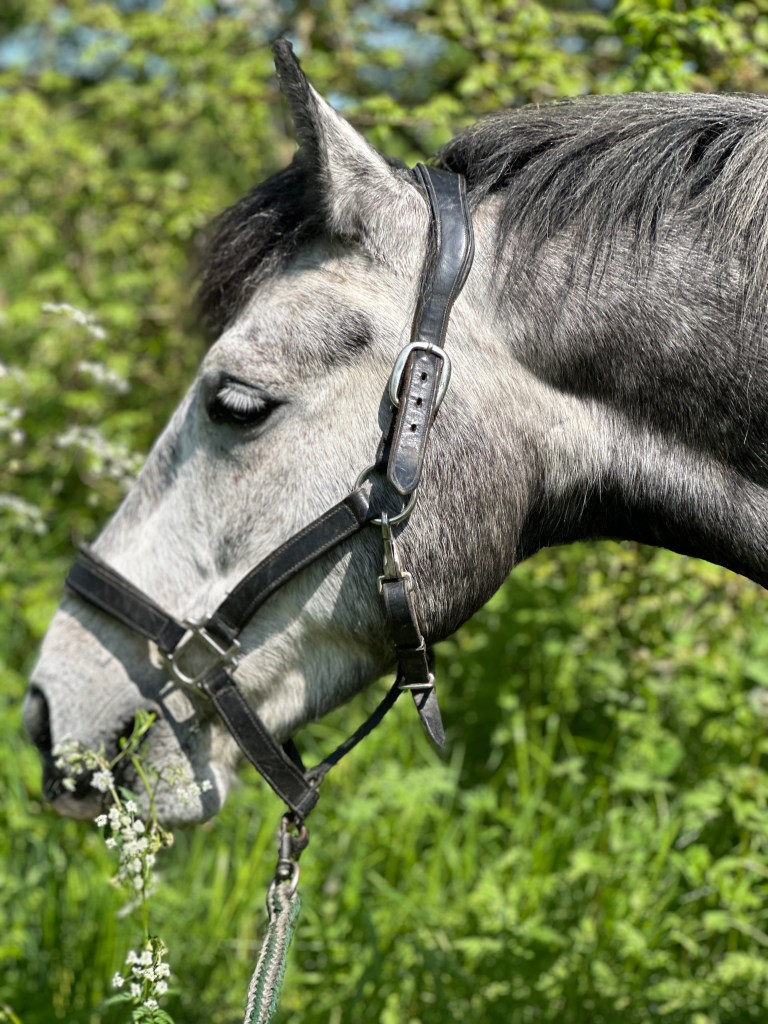
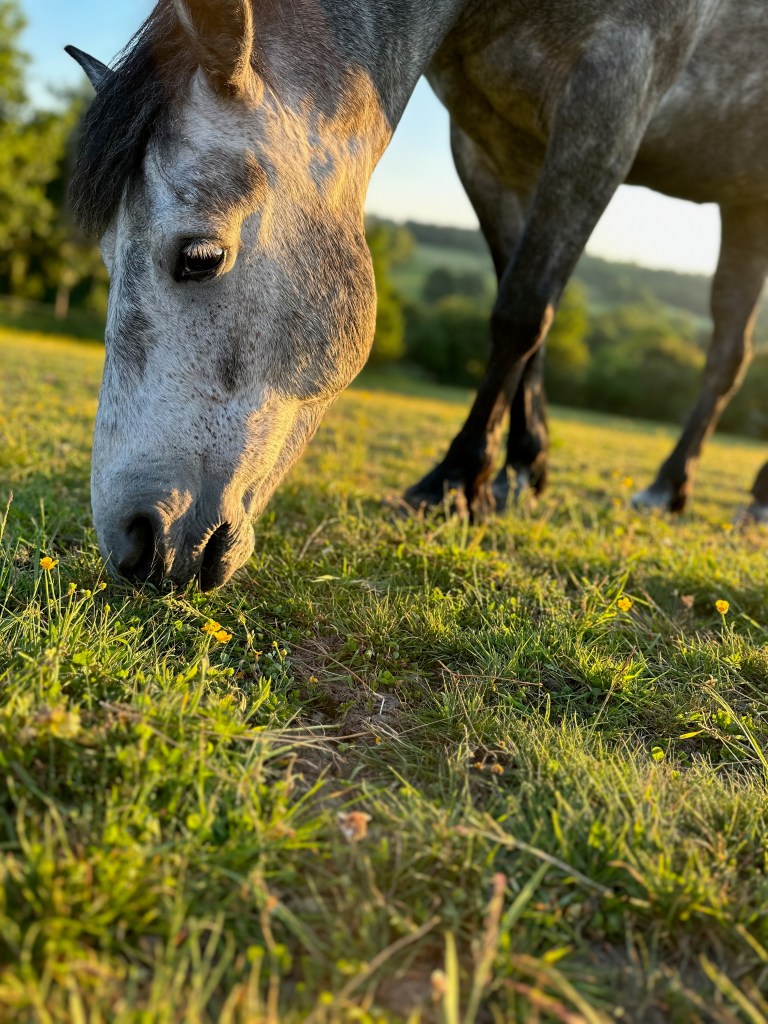
We forage – it’s great to see what they pick to eat
Alongside Mac’s progress, we work on me, the bent shoulders, the crookedness through my body, and a whole set of Pilates exercises that really do make a difference. Slowly but surely, some of the old riding habits that don’t serve the horse begin to fall away. (It’s definitely still a work in progress.) Mac seems to approve. He’s brighter, more willing, and just… happier.
We’re still following the supplement regime for PSSM2, and the signs are good. In our lessons, he now powers straight down the long sides. We no longer have to stop halfway through for a snooze (yes, really, that was a regular thing in the early months). We’ve reintroduced canter, first from the ground, and now from the saddle. It’s stronger, more confident. He’s no longer ‘Eeyore’ around the yard, he moves with purpose. We hack for longer. He flies around the Somerford Farm Ride like he owns it.
Rachel Chadfield, Mac’s physio, continues to visit regularly. She assesses Mac’s musculoskeletal health, treats areas of tension with Indiba therapy, and tracks how his body is adapting to the work we’re doing. At her most recent visit, she could feel real improvement, but noted he’s still carrying a lot of tightness through his shoulders. One issue I can’t seem to get on top of is his persistent cough.
We attend a training session across the 80 acres at Somerford. It’s like riding another pony. Mac coughs through the entire session and feels like he’s wading through treacle, heavy, stuck, lacking spark, we have to put him behind another lead horse to encourage him forward. The trainer isn’t impressed and strongly recommends we get him scoped.
So, we do. The scope doesn’t show anything obvious, but when the tube goes down, Mac coughs, hard, and the vet is surprised. She prescribes steroids. I’m sceptical, as always of the route that leads to big pharma. But of course, I follow my instructions…
Enter Lindsay stage left – Because every pony deserves a fairy godmother………..
The first lesson, we walked. And walked. In fact, we halted for most of it. I remember thinking, This is a bit weird… I mean, I know we’re not exactly Grand Prix ready, but a whole lesson at the walk?
But here’s the thing – I was completely fascinated. What Lindsay was teaching me made sense in a way nothing else had. Let’s be honest, the traditional “he should be able to do this by now” approach hadn’t exactly been a roaring success, had it?
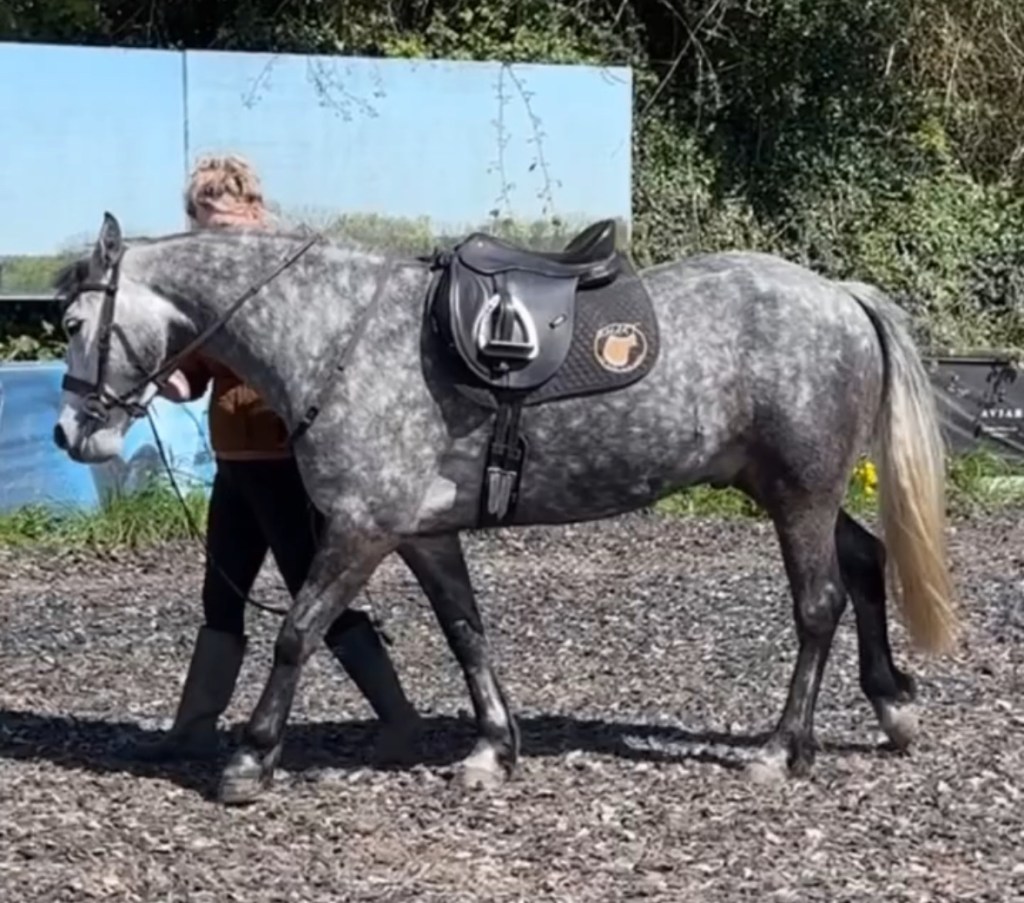
Working from the ground with Lindsay. With focus on Mac’s very stiff shoulders.
Finding Our Feet
One of the many bits of luck in this journey is that Lindsay’s yard is only about 15 minutes from me. So I was able to travel there for lessons, much easier logistically, and a lot more inspiring.
The first time I arrived, though, I’ll admit I felt a bit overwhelmed. I walked through the smart stable yard, big dressage horses peering over the doors at me and Mac. There we were: my little Connemara and me, a 50-something rider who’s a bit of a jack of all trades, and definitely not a master of any.
But Lindsay quickly put me at ease. She said she was happy to teach most horses and riders, as long as they were open to learning. That mattered. That meant something.
Hooked on the Walk
We booked a second lesson later that month. Again, we walked. Again, I was hooked.
Lindsay has this quietly brilliant way of communicating. She brings with her an encyclopaedic knowledge of horse bodies, human bodies, and how they move in harmony. Add to that her calm confidence and an instinctive understanding of what both horse and rider need, and you’ve got a pretty powerful combination. It’s all delivered with empathy, kindness, and a good dose of humour.
By the end of that second session, I knew two things:
I had a lot to learn.
I’d found the teacher I’d been looking for.
A Diagnosis
At the start of our third lesson, Lindsay gently suggested something I hadn’t considered, she thought Mac might have PSSM2. It’s a condition more commonly seen in warmbloods, and she recognised the signs right away; two of the horses she rides have a confirmed diagnosis.
At one point, Lindsay rode Mac herself. I was both relieved and horrified to see that even with her in the saddle, he still moved down the long side like a banana, curved and bent when he should’ve been straight. On one hand, I was secretly pleased, it wasn’t just my riding. On the other, I was worried: If he’s still like that with her, surely there’s something seriously wrong…
By the time the results arrived, we were already managing him as if he had PSSM2. Daily low level exercise, we added high-quality magnesium, amino acids and liquid vitamin E to his diet. Sure enough, the test confirmed he was n/P2.
I was devastated.
But Lindsay was calm and reassuring. “Don’t worry,” she said. “He can still have a normal life. You just need to manage the symptoms—and accept that it will take him longer then other horses to reach each milestone.”
A New Routine
The results came in December 2023. By then, I had already:
Started moving him daily—sometimes just 30 minutes in-hand
Adjusted his diet with PSSM-specific supplements
Watched the weather forecast like a hawk and rugged him accordingly
We continued to visit Lindsay a couple of times a month, focusing on groundwork to build strength. In between visits, we kept hacking the hills.
And gradually, over the winter, we began to see improvement.
Changing Me Too
But the transformation didn’t stop with Mac.
Lindsay also found me a place in her Equipilates class. I’d done a year of online rider Pilates and dipped in and out of yoga over the years, but this was something different. Weekly, live, in-person classes with the same person retraining my riding? I was thrilled.
And I had no idea how much it would change me.
Eighteen months in, I’m straighter, more flexible, and stronger than I’ve ever been. It’s always been said I walk like a farmer (fair!), and my shoulders were notoriously rounded. We’ve worked on those shoulders a lot. A lifelong friend, who’s also a physio and has known me since I was 11, recently noted my posture is better than she’s ever seen it.
I’ll admit it: I’m a little obsessed. I have all the equipment at home and aim to complete two additional online classes from the Equipilates library each week. I even have a pre-ride routine to get myself ready to be the rider Mac deserves.
As Lindsay would say: “Be the rider your horse would choose.”
And outside the yard? I’m pain-free, strong, supple, and found myself dancing around the kitchen last weekend feeling more like a ballerina than a farmer.
Year 5 – Down to the bottom and back again – The Restart: Signs We Couldn’t Ignore
Mac had the winter of 2022/2023 off, time to rest, grow, and hopefully come back stronger. We brought him slowly back into work in the spring of 2023, starting with plenty of roadwork and gentle hacking.
In hindsight, he was noticeably worse, steadier, stiffer, and less forward than before. But I pushed on, thinking maybe he just needed to rebuild fitness.
About 8 to 12 weeks after we restarted, Mac went for his first proper lesson.
At first, he managed to canter, just about, on the right rein. He got around the arena and even pulled off a 20-metre circle, though it was hard work. On the left rein, though, the canter was barely there. Disjointed, weak, unbalanced, like he simply couldn’t get his body to do it.
For the next few months, we returned to hacking and strength work. I was under no illusion, at five, Mac simply wasn’t ready to work consistently in the arena. So, we focused on what he could manage, and what we both enjoyed.
We hacked out with friends, took our time, and began to rebuild confidence. Mac even competed in a TREC competition with a friend and her horse. He was brilliant with the obstacles, especially the gate, the bridge, and the rein back. Calm, clever, and focused.
But there were still signs of discomfort. During Day 2, particularly while completing the PTV (Parcours en Terrain Varié) phase, an obstacle course designed to test control, obedience, and partnership over varied terrain, we noticed a lot of tail swishing, we were now riding in his third tree’d saddle. Something still wasn’t right.
That weekend, I was introduced toSMART Saddles, they are treeless but look like a traditional tree’d saddle, and I brought home an ex-demo to try. It was a game changer. Mac moved better almost immediately, straighter, freer, and noticeably more comfortable. For the first time, I felt like the saddle was helping, not hindering him.
On the first day of TREC, he did run out of energy toward the end of the 12km ride. We finished the last section mostly at walk, and our scores reflected the slower pace. Still, we came away with a very respectable second place, and a quiet sense that we were finally starting to piece the puzzle together.
Just as I was beginning to accept that Mac might never be the pony I’d hoped for, everything changed. I met Lindsay, the founder of Equipilates® and LWR Dressage & Equitation Science Training, a brilliant dressage trainer and coach who uses Pilates-based techniques to help riders become more balanced, aware, and effective in the saddle.
It was the beginning of something completely different, not just for Mac, but for me too. Lindsay didn’t see a difficult pony. She saw a body that was struggling, and a rider who wanted to help. Her approach, insight, and empathy opened a door that changed everything for us……………………….
When we first started working with Mac, we didn’t yet know about Equitation Science.
A Gentle Pony, a Big Ask
Mac is a calm and gentle pony. From early on, he tried to tell us things—through his body language, his posture, and sometimes through resistance, but we didn’t always understand what he was saying. We now realise that before backing him, he needed more structured groundwork, not just to teach obedience, but to help him build the physical strength and confidence required to carry a rider.
At the time, we didn’t know how important it was to:
Strengthen his postural frame before adding weight
Break down each stage of learning into clear, single steps
Give him the chance to process, communicate, and grow confidence
Shutting Down, Not Acting Out
Mac didn’t explode or act out. He did something quieter, and harder to spot: he shut down. He became introverted, less expressive, and harder to read. It wasn’t dramatic, but it was a red flag we didn’t yet know how to interpret. In hindsight, we can see that his behaviour reflected both emotional stress and physical discomfort, which we later discovered was connected to hismuscle health.
At the time, we didn’t know the science. We didn’t realise that a horse shutting down can be a survival strategy, not a sign of compliance, but a loss of confidence or hope.
Enter Equitation Science
Learning about Equitation Science has changed everything for us. With our trainer’s help, we’ve started to rebuild Mac’s trust in training – step by step, moment by moment. ESI has given us the tools to:
Understand why he reacts the way he does
Use clear, consistent signals so he’s never confused
Allow him to communicate, without punishing him for expressing fear or uncertainty
Support him physically, not just emotionally, by working in postures that strengthen rather than stress his body
It’s not about blame. It’s about progress. We know more now, and we’re doing better, for Mac and for ourselves.
Why This Matters for the Horse World
Horses like Mac don’t just need obedience. They need education, clarity, and trust. They need trainers who understand how horses learn, and who are willing to listen just as much as they lead.
We believe it’s time for:
Horse owners to feel empowered to ask questions and learn
Welfare and performance to be treated as the same goal, not separate ones
We can’t go back, but we can move forward, smarter, softer, and stronger.
Bringing Mac Home After the search that began during lockdown and led us to a small, reputable Connemara stud in Oxfordshire we met the pony who would change everything. Mac was a two-year-old colt: well-bred, well-handled, and already showing the kind temperament and curious spirit we were looking for. He was bold but gentle, moved beautifully, and followed us around the field from the very first visit. We brought him home full of hope and excitement for the years ahead, a once-in-a-lifetime pony for both me and my son.
Mac was naturally curious and kind. He was one of those ponies who always wanted to be with you in the field, interested in everything that was going on. Even at that age, he had a special presence, the kind that makes you feel lucky every time you see them.
Growing Up – Bright but Itchy
Before we ever sat on him, there were little signs that something wasn’t quite right. He was itchy, really itchy. I remember wondering whether he might develop sweet itch. His tail was a constant target, and no matter what I did, I couldn’t get him to stop rubbing it. I tried countless herbal remedies and treatments. Some helped to a point, but the itch was always just beneath the surface. And he lay down all the time!
Mac and Bill winter 2020
We took our time with him, no pressure, just letting him grow and settle. But quietly, in the background, there was always this sense that something didn’t quite add up.
The Change After Backing
When it came time to back Mac, we kept everything slow and quiet. He accepted the process willingly. There were no explosions or arguments, he simply allowed it. But something had changed.
Where he had once been bright and alert from the ground, under saddle he became dull. Not resistant, not reactive, just flat. Uninterested. That spark of curiosity we’d known so well seemed to disappear the moment we sat on him.
He wasn’t sensitive to the leg or saddle. In fact, he felt the opposite, disconnected. Almost as though riding didn’t register as something important to him.
Strength Work That Didn’t Work
We started hacking him out gently, building up with long hill walks, and we have plenty of hills around here. Mac was excellent in traffic, barely even noticing the lorries or cars on our busy main road. It was the one time he seemed more like his old self, alert and forward, as long as it was flat! Ears pricked, taking it all in.
But as the summer wore on, it became clear something was wrong.
No matter how much steady fitness work we did, no matter how many hills we climbed, Mac didn’t get fitter. He stayed sluggish, and he never really developed strength or stamina the way a young, healthy pony should.
So, in late autumn, we turned him away for a long winter rest, thinking perhaps time and a break would help………………..


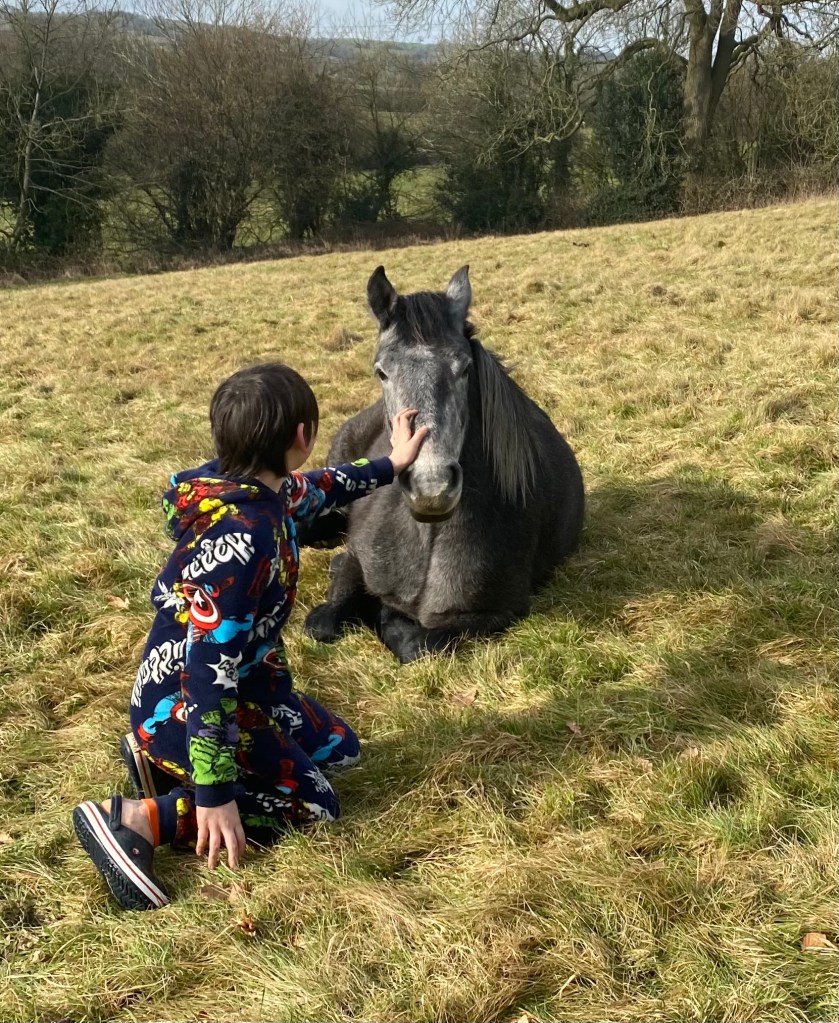
 Mac and Me